
From a vacancy to a new starter, fairly.
Recruitment takes a vacancy from draft to filled, with the criteria applicants are scored against agreed before anyone applies. The panel scores blind, every decision is on the record, and the details of people you did not hire are removed after your retention period.
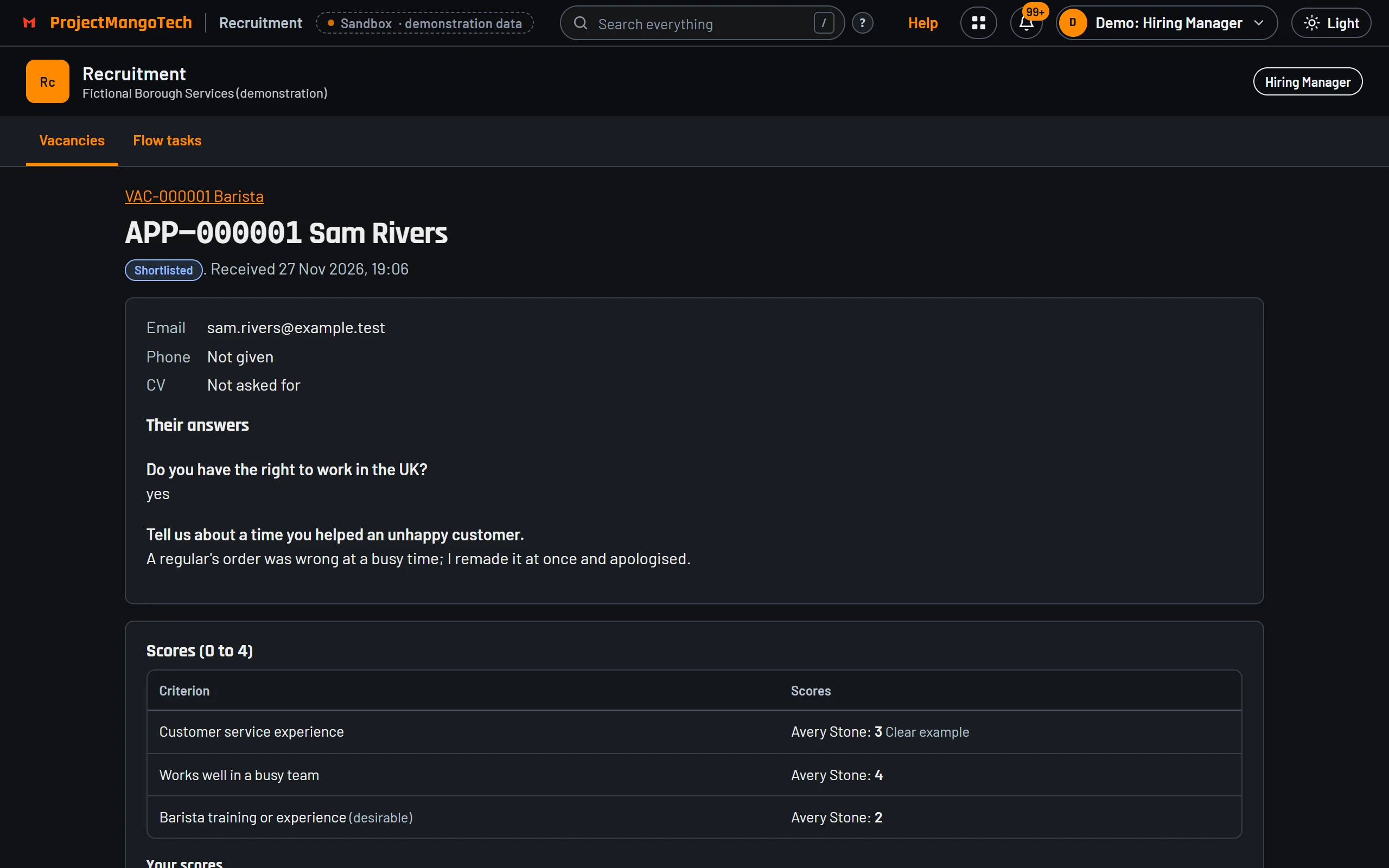
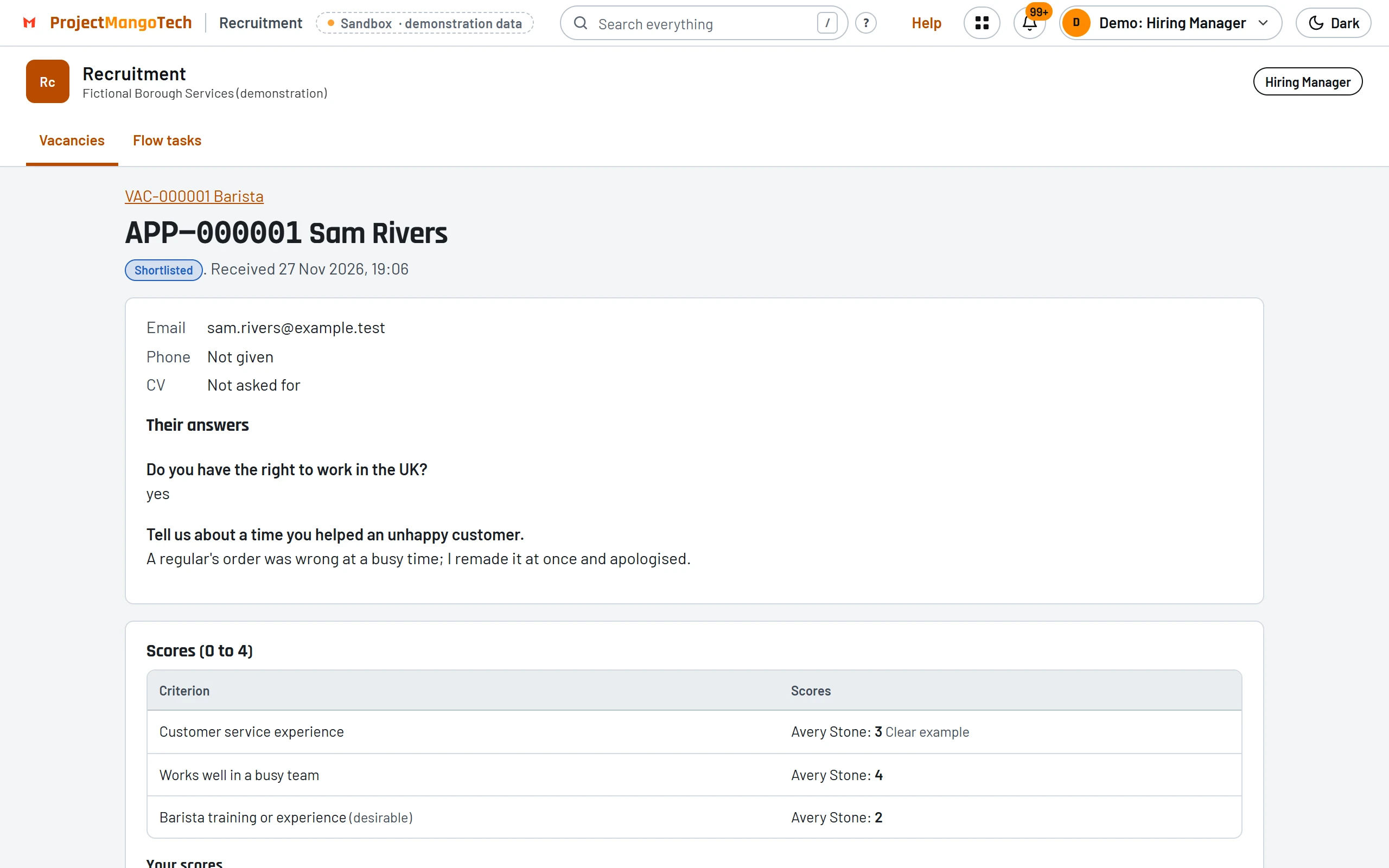
What Recruitment does for you.
A second person approves the vacancy and its criteria.
Ask what you need to know, and ask for a CV only where you want one.
The panel scores against the criteria without seeing each other's marks.
Vacancies are published to a careers page applicants can use without an account.
Applicants who were not hired are removed after the retention period you set.
The new starter goes to HR once the offer is accepted.
Everything you'd expect, and what a standalone applicant tracking system often can't.
| What it does | Recruitment | A typical standalone applicant tracking system |
|---|---|---|
| The job description from JD Manager, from the same skills library | Included | No |
| Steps in processes that run across departments, with Flow | Included | No |
| Its to-dos in Core's one list of what is waiting, and its records in one search across every applet | Included | No |
| A second person approves the vacancy and its criteria before it opens | Included | Often extra |
| The panel scores blind against criteria agreed before anyone applied | Included | Often extra |
| Offer letters signed online, in Signatures | Included | Often extra |
| The new starter goes to HR, filled in from the application | Included | Often extra |
| Its reports in Core: build your own in a sentence, present full screen, emailed on a schedule, live in Excel and Power BI | Included | Often extra |
| Your own careers page. Applicants apply without an account | Included | Usually |
| Screening questions, and a CV only where you want one | Included | Usually |
| Interviews planned, applicants moved through stages | Included | Usually |
| Applicants not hired removed after your retention period | Included | Usually |
No: it needs Core's other applets working together, so a standalone tool can't. Often extra: an add-on, a higher plan, another product or a connector to set up. At launch: arrives before Core goes on sale in January 2027. What a typical standalone tool offers is our reading of popular UK tools of each kind in November 2026; individual products vary.
Nothing typed twice.
Recruitment passes its work to the applets beside it and hears back from them, so the same thing is never entered twice.
Everything every applet needs, already there.
Recruitment uses Core's one sign-in, knows your people and their roles, sends to the same bell, and keeps every change on the record. Switch it on beside the applets you already use, for one price set by the size of your organisation.
Learn it in minutes.
Questions about Recruitment
Do applicants need an account?
No. They apply from your careers page without one.
How do you keep scoring fair?
The criteria are agreed and approved before anyone applies, and each panel member scores without seeing the others' marks.
How long do you keep applicants' details?
As long as the retention period you set. After it, the details of people you did not hire are removed.
What happens when someone accepts?
The offer letter is signed online, and the new starter goes to HR with their details already filled in.
Applets that work alongside it.
Core opens soon.
We're getting Core and its 24 applets ready for their first organisations. Tell us what yours needs and we'll let you know the day the sandbox opens.